GROUND SOURCE HEAT PUMPS
A ground source heat pump is the most efficient and stable heating solution; it uses heat from the ground or groundwater. Unlike air-to-water heat pumps, a ground source heat pump does not depend on the air temperature, because the heat of the ground stays stable all year round. It is a long-term investment that gives the lowest heating costs and the highest energy efficiency.
Advantages of a ground source heat pump
Highest energy efficiency
A ground source heat pump uses up to 4–5 times less electricity than traditional heaters because it draws on the stable heat of the ground.
Independent of air temperature
Unlike air-to-water heat pumps, a ground source heat pump works equally efficiently in a cold winter and in summer.
Long service life
The collectors of a ground source heat pump last 30–50 years, and the unit itself 20–25 years.
Quiet operation
The unit is installed indoors and makes no noise outside.
An environmentally friendly solution
It uses renewable energy from the ground and produces no CO₂ emissions.
Heating, cooling and hot water
One unit provides all three functions.
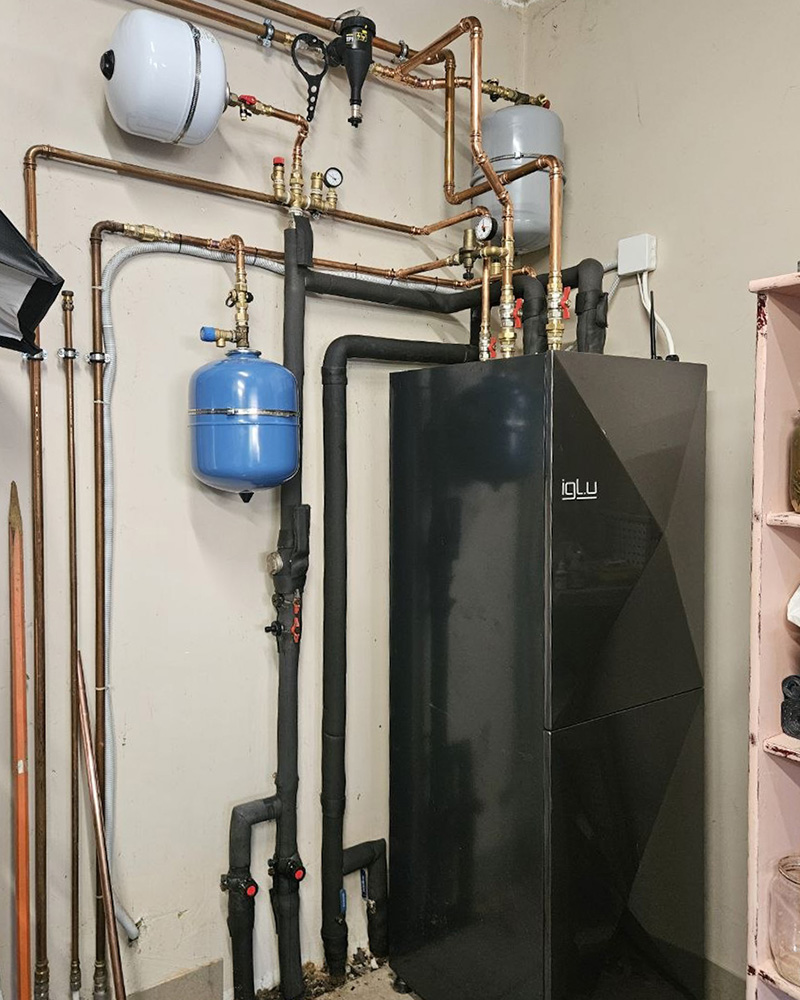
How does a ground source heat pump work?
A ground source heat pump takes heat from the ground through a system of collectors or boreholes. A special fluid circulates in the ground or groundwater, absorbs the heat and passes it to the heat pump. The pump raises the temperature of this heat and transfers it to the heating system – an underfloor heating circuit, radiators or a water heater. Because the ground temperature at a depth of 1,5–2 m stays stable (+8–12°C) all year round, a ground source heat pump works efficiently in both winter and summer.
Who is a ground source heat pump suitable for?
Private houses from 150 m² with an underfloor heating system.
New-build houses, where the collector system can be designed in advance.
Houses with a larger plot. Horizontal collectors need enough space.
Properties where long-term energy efficiency and minimal heating costs matter most.
Commercial properties with a high heating demand.
Houses where gas cannot be connected or the owner wants to give up fossil fuels completely.
Stages of ground source heat pump installation
Types of ground source heat pump
Horizontal collectors
Horizontal collectors are laid in the ground at a depth of 1,5–2 m in horizontal pipe loops. This solution is cheaper than boreholes but needs more land – about 2–3 times the floor area of the house. It suits houses with a larger plot.
Vertical boreholes
Vertical boreholes are drilled to a depth of 50–150 m. This is a more expensive but more compact solution, suitable for smaller plots or densely built-up areas. Boreholes reach a more stable ground temperature and so give higher efficiency.
Groundwater systems
These systems use groundwater as the heat source. This is the most efficient ground source solution, but it requires suitable geological conditions and permits for water use.
Want the most efficient and stable heating solution? Get in touch – we will assess the conditions of your plot, suggest the most suitable ground source heat pump and install it anywhere in Lithuania.
OUR PARTNERS
We are official representatives of these companies:
Viessmann, Immergas, Vaillant, Sime, Baxi, Wolf, Protherm, Rotenso, Ravenheat, Bosch, Junkers, Buderus.
visukatiluremontas.lt – ground source heat pump installation across Lithuania